






































Juan Cesar Bonilla y Julia Patricia Vergara
Workshop: Taller tagua Bonilla y Vergara
Craft: Work with non-timber products
Trail: Ráquira - Chiquinquirá Route
Location: Tinjacá, Boyacá
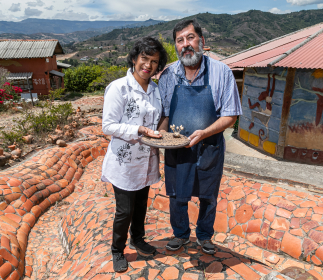
This story begins in the early 20th century. At least, that’s what anthropologists recorded in 1917, noting the use of seeds resembling stones in artisanal crafts in the Boyacá department, specifically in Chiquinquirá. Alongside these seeds appeared a surname: Bonilla. César Bonilla, the grandson of that first Bonilla, Florencio Bonilla Vargas, is today the heir to the craft of tagua, also known as vegetable ivory, in Tinjacá. Though César is featured in the iconic book “Maestros del Arte Popular Colombiano”, he begins his story by highlighting the work of his own father, Alfonso Bonilla, who won the Master Craftsman Medal in 1976. In other words, this is a family dedicated to the craft of tagua.
César has devoted his life to researching tagua, a palm from the genus Phytelephas. The etymology of its name, combining “plant” and “elephant,” directly alludes to its reputation as the vegetable ivory. This towering palm, with branches emerging from the ground, grows throughout the Colombian Pacific coast and the swampy regions of the Magdalena Medio. Besides being abundant, it is a generous plant that, once it starts producing seeds—around seven years after its birth—continues to yield them for over fifty years. César firmly believes that this could be one of the country’s most sustainable artisanal materials.
But let’s start from the beginning. It all began with Don Florencio, a cabinetmaker and gold leaf worker, who in his spare time would hunt along the Magdalena Medio’s shores in the humid, warm lands of San Pablo de Borbur. There, he was captivated by brown fruits shaped like pineapples, as large as basketballs, which contained twenty to thirty-five seeds each. Being a carver, he was intrigued by how these seeds would behave, so he took them back to Chiquinquirá and started exploring this new material. He crafted toys like tops, cups and ball toys, and yoyos from them, which he showcased at artisan fairs during the Virgin of Chiquinquirá festivals. The toys were a hit, especially because his wife, Doña Filomena, who worked at the old Coltejer factory and learned to hand-paint fabrics in Medellín, added vibrant colors to Florencio’s creations.
César speaks with admiration of his father Alfonso but admits that he received little formal instruction from him. Alfonso was the type of man who wanted his children to achieve more than he had, and he would push César to study, often shooing him away from the workshop if he asked about tagua. César ended up studying Social and Economic Sciences with a focus on History. It was there, in academia, that one of his professors made him realize that the knowledge in his family was a treasure not to be wasted. Fortunately, his sister Carmen Elisa, who suffered from epilepsy and received much care from Alfonso, inherited the craft. Her father found in the craft a way of soothing her illness. She taught César everything—from turning techniques to polishing and carving—which he now excels at. César acknowledges that women have been his guiding force; his sister and his wife, Julia Patricia, an artist and designer with whom he has formed a successful working duo, have elevated the craft of tagua to new levels of sophistication.
Today, in his workshop in Tinjacá, near Ráquira, César offers over two hundred product variations, many of which are stunning miniatures, such as chess sets that are a visual delight. They are also working on combining tagua with wood and using tagua shells in mosaics to create utilitarian objects like containers. Julia has even ventured into making paper from tagua to ensure that not a single millimeter of the raw material is wasted. The Bonillas, now with new surnames accompanying the tagua craft, will continue to uphold their legacy and remain the best ambassadors of this botanical realm.
Workshop and process


Craft


Artisans along the way

Artisans along the way



No puede copiar contenido de esta página
