






































Blanca Nubia Sierra
Workshop: Taller Arte y Tradiciones Ancestrales
Craft: Weaving
Trail: Ráquira - Chiquinquirá Route
Location: Ráquira, Boyacá
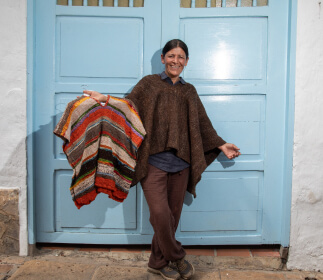
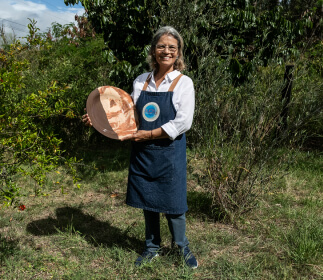
Blanca Nubia has no qualms about admitting that her greatest inspiration in life has been her father. She feels incredibly fortunate to have been born with the title of a campesina weaver, thanks to him. And she adds, without losing her train of thought, that life has taught her not only to be a weaver of fibers—specifically esparto—but also a weaver of words. And indeed, she is. She has a flair for language, weaving elaborate narratives that show how a story can be a comforting, enveloping, and vindicating fabric. For this reason, sharing her land, heritage, and pride has become her mission and the legacy she wants to leave her children.
Don Faustino Sierra Cárdenas may not have attended school, but he read everything and navigated the world with the wisdom of intuition, experience, and kindness. As a coffee picker in Tolima, he also grew potatoes in the highlands. Later, in Ráquira, he would take his daughter on horseback every Saturday to gather the week’s work, the esparto baskets production. He taught her the craft, and she always saw him working and heard him recounting the ups and downs of life, advising her to study and read without complaint, and to learn to fend for herself in this world because there was no other choice. He also taught her the importance of giving to receive, a lesson she was to remember always. As they walked through towns, many people would thank him for shoes for their children, notebooks, or fabric for uniforms. It wasn’t just one person but many who whispered to her, “He used to bring the groceries, and never did we lack salt or panela for the kids,” showing her the real-life lessons he imparted. How could her life be any different?
Now, about esparto. Her grandmother Abigail and her mother Paz—the way Faustino called Pasión—were skilled weavers of esparto, the fiber that characterizes the basketry of this part of Boyacá, particularly known in Ráquira and Cerinza. Famous are the lunch baskets and pot holders, woven wraps placed under clay pots for beans or ajiaco. Thus, the perfect combination of esparto and clay is a hallmark of Ráquira. And Blanca actually has a story about these baskets. She recounts a time when she became fed up with the low wages offered to all weavers—8,000 pesos per dozen pot holders. This was the case in her town, but also in Bogotá, in Pasaje Rivas, and at markets like 7 de Agosto, Paloquemao, 12 de Octubre, and Las Flores. The price was simply too low. She vividly remembers returning to Ráquira with all the merchandise because she refused to sell it at that price. She took radical action, selling a cow she owned and using the proceeds to buy the entire stock of every weaver for a month. This forced the market, hungry for pot holders, to reconsider its pricing. And it worked—the price rose to 15,000 pesos and now stands at 20,000 pesos.
Everything she has done has been in pursuit of artisans’ dignity. That’s why she founded the Taller Arte y Tradiciones Ancestrales, formed alliances with universities to think about the environmental sustainability of raw materials, and connected with artisan organizations like Artesanías de Colombia and those interested in community tourism to train operators. She also works to strengthen traditional cuisines. She understands that when an ecosystem is healthy and shares its knowledge, everyone benefits. Blanca is a weaver of relationships, partnerships, agreements, and knowledge to ensure that skills are preserved, and to keep pace with the market and innovation. That’s why she celebrates projects she’s done with other artisans and designers, elevating her product to a higher level—it’s what she seeks and desires, and it’s what she has instilled in her younger daughter, Daniela, another eager participant in building teams with experienced artisans to preserve traditions while embracing the future.
Workshop and process


Craft


Artisans along the way
Artisans along the way



No puede copiar contenido de esta página
