



































María Daniza Sáenz
Workshop: Tejidos Dansa, Asociación de Mujeres Herencia Muisca (16 mujeres)
Craft: Weaving
Trail: Ráquira - Chiquinquirá Route
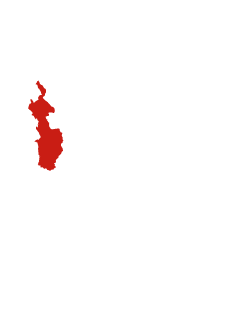
Location: Villa de Leyva, Boyacá
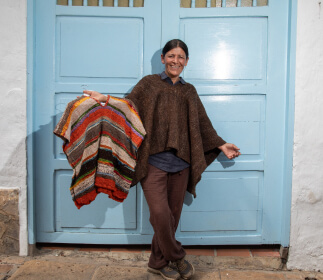
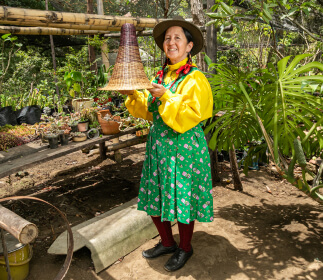
María Daniza describes herself as a true country woman and a proud heir to her father, Herminio Sáenz. He was one of those rugged men of the countryside who could do anything and wasn’t deterred by anything. He wove cloaks and blankets to ward off the cold, made fique bags for carrying vegetables, crafted clay pots for cooking, fetching water, preparing chicha, and eating, tanned hides to make leather for sleeping mats, and even carved yokes and plow parts for oxen.
Today, María Daniza speaks of this past with a hint of nostalgia in her voice, as her father was a great inspiration to her. She acknowledges that she only came to truly honor him later in life, when she had little time to fully appreciate him. But as if trying to settle a score with life, she and her husband, having married at a young age, decided that weaving and becoming an ambassador for what it means to be from Boyacá would be her life’s work. And that’s exactly what she’s done. So, in addition to her artisanal tradition, she’s incorporated community tourism. Now, at 60 years old, she knows she’s done well, but also understands that in the battle for identity, nothing is guaranteed. Villa de Leyva has paradoxically become a multicultural hub where a myriad of cultures coexist, blurring any sense of traditional local practices and making stories and products compete with one another.
Nonetheless, she recognizes the value and charm of her tradition. That’s why she has fully committed to showcasing it in all its glory, adding value to the artisanal work of wool weaving in its various techniques—loom weaving, two-needle knitting, and macramé. In addition, showing the process of wool, from start to finish, is a very appealing element. She knows that presenting visitors her sheep helps them understand the long journey involved in creating a ruana, a shawl, or a pair of gloves. The sheep that teach us about this natural world are Pequitas, Manchitas, Cachitos, Byron, the newborn lamb, and Rodolfo, the big, chubby ram. With them, we see that shearing a sheep is a serious business, as once the wool is removed, it must be reserved for at least a month before it can be washed. After that, it must be carded or cleaned, spun, twisted, and prepared as cleanly as possible for weaving—a process that can take several months since spinning wool isn’t the main activity for these women. After all, who can survive on the 20,000 pesos per pound they’d earn for a day’s work?
María Daniza has made demonstrating her craft the best way to tell the story of wool. She understands that showcasing the preparation of raw materials is the most effective way to convince tourists of the value of hand-woven crafts. She also seeks to highlight the spinners who are often the unsung heroes of the craft, acknowledging that it is their patience and skill that give a ruana its soft touch. Her workshop has become a space to celebrate the craft in all its stages, and to combine it with a hearty country meal of sancocho or Boyacá stew, topped off with cuajada with melao, made from the milk of neighboring cows. It’s an experience you shouldn’t miss when traveling to Villa de Leyva, offering a glimpse into a piece of this coloured land’s rich history.
Workshop and process


Craft


Artisans along the way
Artisans along the way



No puede copiar contenido de esta página
